Search by AI: From Blue Links to Direct Answers
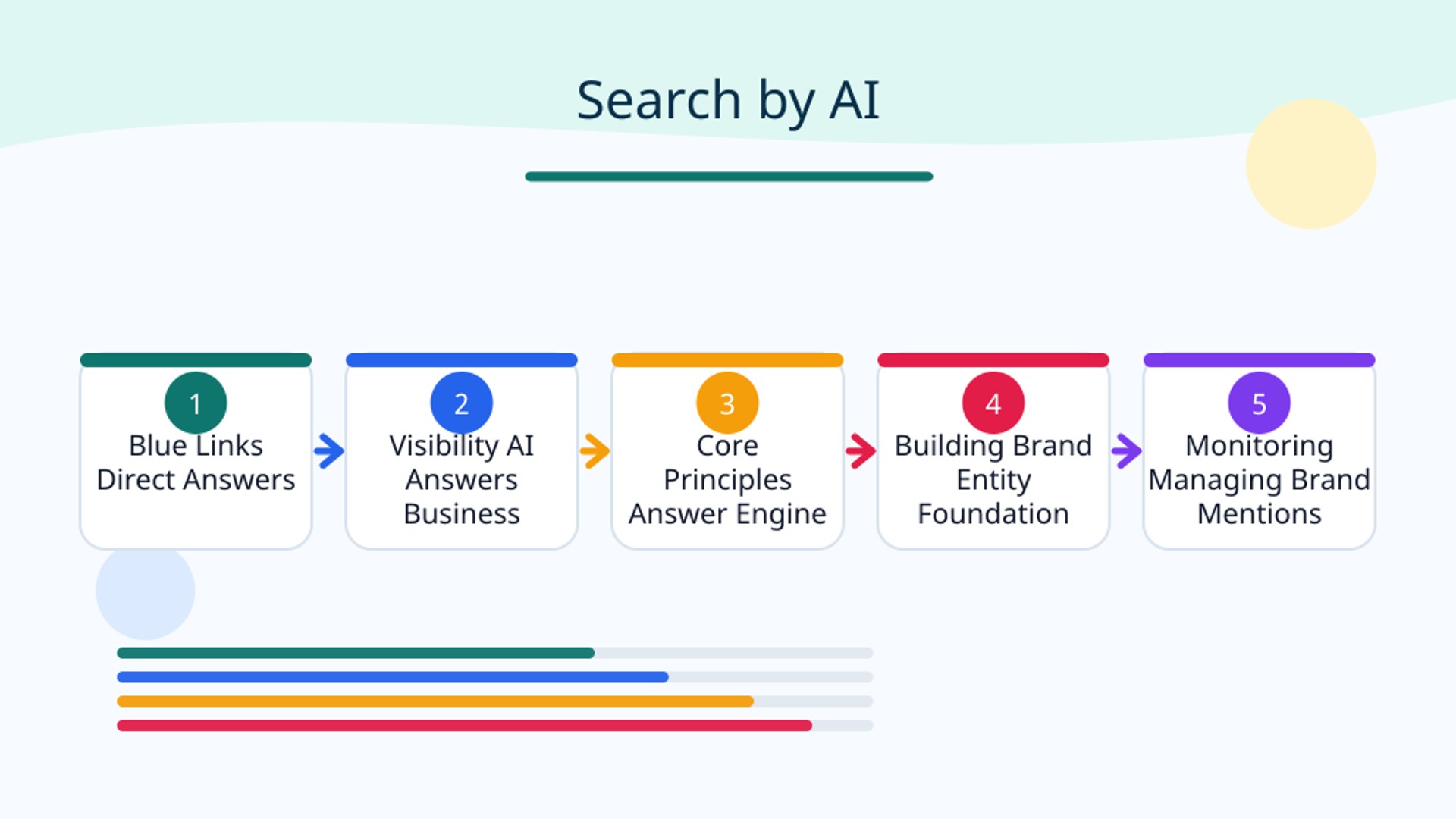
From Blue Links to Direct Answers: The AI Search Revolution
The familiar landscape of search, long defined by a list of ten blue links, is undergoing a fundamental revolution. We are moving away from a model where users sift through links to find information and into an era of direct answers, where AI synthesizes information and presents a single, conversational response. This shift from clickable links to definitive answers is not an incremental update; it is a complete re-imagining of information discovery.
For any business, this transformation redefines the concept of online visibility. The traditional goal of ranking high on a results page is becoming insufficient. The new business imperative is to become a trusted, citable source for the AI models that generate these direct answers. When an AI cites your brand as the authority behind its answer, you gain a level of credibility that a simple link could never provide. This makes adapting to the new rules of search a core strategic priority.
Navigating this revolution means understanding how platforms like Google's AI Overviews, Perplexity, and conversational models like Gemini and ChatGPT find, vet, and present information. The core principles of authority and expertise are more critical than ever, but they must be applied through the new lens of Answer Engine Optimization (AEO). The goal is no longer just to be found, but to be the answer.
Why Visibility in AI Answers is a Business Imperative
The transition from a list of blue links to a single, synthesized response represents a fundamental search revolution. For any modern business, achieving visibility within these AI-generated results is not a future goal but a current imperative. When users receive direct answers from platforms like Google AI Overviews or Perplexity, their journey often ends there, bypassing your website entirely. In this new paradigm, being the cited source is the new top-ranking position.
This shift directly impacts core business outcomes in several critical ways:
- Authority and Trust: When an AI model cites your brand as the source for an answer, it confers immediate authority. You become the trusted expert in the user's mind, a powerful brand impression that occurs even without a click. Conversely, invisibility allows competitors to own the narrative and capture that trust.
- High-Intent Traffic Capture: Users turn to AI for complex, decision-oriented queries. Being the source for these answers places your brand directly in the consideration phase for high-intent customers, influencing purchasing decisions at the most critical moment.
- Narrative Control: If you don't provide the definitive information about your products, services, or industry, AI models will source it from third parties. Proactive Answer Engine Optimization (AEO) is a form of reputation management, ensuring the AI's understanding is built upon your accurate, authoritative content.
Securing this placement requires a deliberate strategy rooted in the core principles of AEO. It involves structuring content to be the clearest possible answer, building your brand as a recognized digital entity, and ensuring your data is machine-readable for models powering ChatGPT, Gemini, and other answer engines. This is not traditional SEO; it is about making your brand the canonical source of truth in your domain.
Core Principles of Answer Engine Optimization (AEO)
The transition from a web of blue links to a world of direct answers necessitates a fundamental shift in strategy. This search revolution demands more than traditional SEO; it requires a deep understanding of how AI models synthesize information. For any business, achieving visibility within these AI-generated responses is a new strategic imperative. The following core principles form the foundation of an effective Answer Engine Optimization (AEO) strategy.
-
Establish Verifiable Entities, Not Just Keywords
AI answer engines like Google AI Overviews and Perplexity rely on knowledge graphs to understand the world. The primary goal is to establish your brand, products, and key personnel as distinct, authoritative entities. This involves using structured data (Schema.org), maintaining consistent information across all platforms (e.g., Google Business Profile, Wikidata, industry directories), and ensuring your digital footprint clearly defines who you are, what you do, and why you are an authority. -
Create Factual, Citable, and Attributable Content
AI models are designed to prioritize accuracy and often cite their sources. Your content must be meticulously researched, factually correct, and transparent about its sources. Each claim should be verifiable. This builds trust with the AI, increasing the likelihood that your data will be used to formulate direct answers. This is a departure from opinion-heavy or thinly sourced articles, which are less likely to be trusted or featured. -
Structure Content for Extraction and Synthesis
Generative AI does not "read" a page like a human; it parses it for extractable information. Structure your content to directly answer anticipated user questions. Use clear headings (H2s, H3s), bullet points, and concise paragraphs. Answering the "who, what, where, when, why, and how" explicitly makes it easy for models like Gemini or ChatGPT to lift your information and present it as a definitive answer. -
Build Authority Through Provenance and Mentions
While backlinks still matter, the concept of authority is expanding. AEO prioritizes provenance—the origin and trustworthiness of information. This means tracking and encouraging brand mentions in high-authority publications, academic papers, and expert discussions. The goal is for the AI to recognize your business not just as a source, but as a primary source of truth within your niche, reinforcing your expertise and influence.
Building Your Brand as an Entity: The Foundation of AI Trust
In the new search paradigm, moving from a list of blue links to synthesized direct answers, AI models act like researchers, not just indexers. They seek to understand concepts and the relationships between them. For your business, this means your website is no longer enough. Your brand must become a distinct, verifiable "entity"—a concept that AI can understand, trust, and cite. This is the foundation of modern digital visibility and a strategic imperative for any organization.
An entity is the sum of all verifiable, consistent, and authoritative information about your brand online. When an AI like Google's AI Overviews or Perplexity formulates an answer, it prioritizes information from entities it deems trustworthy. Building your brand as a robust entity is therefore one of the core principles of AEO, directly influencing whether your data is used to shape the answers users receive.
Key Pillars of Entity Building
To establish your brand as a trusted entity, focus on creating a clear and consistent digital footprint that AI can easily parse and validate. This is a central part of the AI search revolution.
- Structured Data Deployment: Use Schema.org markup on your website to explicitly tell search engines what your business is, what it does, who runs it, and where it's located. This structured information acts as a direct, machine-readable brief about your entity.
- Knowledge Graph Integration: Ensure your brand has a comprehensive and accurate presence in key knowledge bases like Wikidata and a fully optimized Google Business Profile. These platforms are primary sources AI models use to cross-reference and verify facts about your entity.
- Consistent Information & Mentions: Maintain absolute consistency in your core business information (name, address, phone number, website) across all online directories, social profiles, and third-party mentions. Each consistent, authoritative mention acts as a citation, reinforcing your entity's legitimacy and expertise in the eyes of AI.
Monitoring and Managing Brand Mentions in AI Summaries
The AI search revolution has fundamentally altered how we measure success. The familiar comfort of tracking rankings for blue links is obsolete in a world of synthesized, direct answers. This new paradigm presents a critical challenge: how does a business track its visibility when there's no "rank" to monitor? The focus must shift from simple positioning to a more nuanced analysis of presence, sentiment, and attribution within the AI-generated content itself.
Monitoring is no longer about checking a position on a list; it's about understanding your brand's narrative as told by an AI. It is a strategic imperative to track several key factors:
- Inclusion and Prominence: Is your brand mentioned at all in answers to relevant commercial or informational queries? If so, is it presented as a primary solution, one of several options, or a minor footnote?
- Context and Sentiment: How is your brand framed? The AI's summary can position you as an industry leader, a budget option, or associate you with negative attributes based on the source data it synthesizes.
- Source Attribution: When AI models provide citations or links, are they pointing to your domain? Securing this direct attribution is crucial for capturing user intent and reinforcing your authority.
- Competitive Landscape: Who is being mentioned when you aren't? Analyzing competitor mentions provides direct insight into whose content the AI trusts more for a given topic, revealing gaps in your own entity and content strategy.
Managing this presence requires a proactive feedback loop. When monitoring reveals negative sentiment or exclusion, the response must be rooted in the core principles of AEO. This involves refining your knowledge graph, publishing clearer and more authoritative content that directly addresses user queries, and ensuring your factual data is unambiguously structured for machine consumption. In the new era of search, brand management and SEO are inextricably linked, and active monitoring is the mechanism that guides your strategy.
Measuring Success in the Age of Zero-Click Search
The paradigm shift from clickable blue links to conversational, direct answers demands a corresponding revolution in how we measure success. Traditional metrics like rank position and click-through rate, while still relevant for classic search results, fail to capture the full picture of brand performance within AI-generated summaries. For any business, adapting measurement is not just an option; it is a strategic imperative to understand and justify investment in this new search landscape.
Success is no longer solely about driving a click. It is about influencing the conversation and becoming the trusted source within the answer itself. The core of a modern measurement framework must focus on brand presence and influence within AI outputs. Adopting these new measurement principles is key to proving the value of your AEO efforts.
Key Performance Indicators for the AI Search Era
- Share of Answer (SoA): This is the premier metric for AEO. It measures the frequency and prominence of your brand, products, or key personnel being cited as a source in AI answers for a target set of queries. Tracking SoA across platforms like Google AI Overviews, Perplexity, and ChatGPT provides a clear benchmark of your topical authority and visibility.
- Citation Quality and Accuracy: Go beyond simple mentions. Are the citations attributed correctly? Do they link back to your domain? Is the information presented about your brand accurate and favorable? Inaccurate attributions or negative sentiment can be more damaging than no mention at all.
- Branded Search Lift and Direct Traffic: While zero-click searches are increasing, successful AI visibility often leads to subsequent, higher-intent user actions. Monitor for correlated increases in users searching directly for your brand name or navigating straight to your website. This indicates that your presence in AI answers is building brand recall and trust.
- Query-Level Answer Ownership: Identify the most critical questions your customers ask. The goal is to consistently be the primary source for the answers to these high-value queries. Track your performance on a query-by-query basis to understand where you are winning and where competitors have an edge.
The Future Trajectory of AI-Powered Information Discovery
The current AI search revolution is merely the first phase of a much deeper transformation. The journey from a list of blue links to conversational, direct answers is evolving into a new paradigm where AI acts as a proactive, personalized agent. For any business, understanding this trajectory is not just advantageous—it is a strategic imperative for future relevance and growth.
As AI models become more sophisticated, the nature of a "search" will fundamentally change. We are moving toward a future defined by:
- Agentic AI Systems: Expect AI to move beyond answering questions to completing multi-step tasks. A user won't just ask for "best project management tools" but will instruct the AI to "compare the top three tools based on my team's workflow, generate a cost analysis, and draft an implementation plan." Visibility here means your product isn't just an answer; it's a viable component in an AI-generated solution.
- Multi-Modal Synthesis: The future of answers is not purely text-based. AI will seamlessly integrate and synthesize information from text, images, video, and structured data to provide a comprehensive response. Brands must ensure all their content formats are optimized for machine interpretation.
- Hyper-Personalization: AI will leverage deep user context—including past behavior, location, and intent—to deliver uniquely tailored results. The value of generic content will diminish, while information that is contextually relevant and entity-rich will become paramount.
- The Source Economy: As direct traffic from traditional search declines, the value of being cited as a primary source within an AI-generated answer will skyrocket. This verifiable attribution is the new currency of digital authority. Adhering to the core principles of AEO is the only way to ensure your brand becomes a trusted source in this new economy.
Navigating this future requires a long-term commitment to building a machine-readable brand entity. The strategies that ensure visibility today are the foundational building blocks for relevance in a world where AI doesn't just find information but actively uses it to reason, plan, and create on behalf of the user.
Frequently Asked Questions on AI Search Strategy
What is the core difference between traditional SEO and Answer Engine Optimization (AEO)?
Traditional SEO focuses on ranking web pages to earn clicks from classic blue links. AEO, in contrast, is about embedding your brand's factual information directly into AI-generated summaries and direct answers. The goal shifts from driving a click to achieving brand visibility and authority within the answer itself. This makes becoming a trusted source a business imperative.
Does the AI search revolution mean traditional blue-link rankings no longer matter?
No, but its role is evolving. Foundational SEO remains a core component because AI models still crawl and learn from the web. Strong technical SEO, authoritative content, and a healthy backlink profile are still crucial. However, this foundation is now the starting point, not the end goal. A strategy that ignores the shift toward direct answers will lose visibility over time.
How can our business get cited in answers from Google AI Overviews or Perplexity?
Visibility in AI answers comes from being recognized as a trustworthy and authoritative entity on a topic. The key principles involve creating clear, factual, and well-structured content on your own digital properties, ensuring your business data is consistent across the web (like in your Google Business Profile and structured data), and earning mentions in reputable third-party sources. The AI must see you as a reliable source for the answers it constructs.
With multiple AI search platforms, where should we focus our AEO efforts?
While the landscape includes Google, Perplexity, ChatGPT, and others, the foundational principles of AEO are universal. The most effective strategy is to focus on building a strong, verifiable brand entity and a library of expert content. This approach is platform-agnostic because every major AI search tool draws from the public web to find reliable information. A robust, core AEO strategy will enhance your visibility across the entire ecosystem.
Is an unlinked brand mention in an AI answer as valuable as a citation link?
In this new era of search, an unlinked mention within a trusted AI answer can be incredibly valuable for brand recall and authority. While a citation link is still excellent for driving qualified traffic, the primary business imperative is to be part of the conversation. Being mentioned as the solution or authority in a direct answer positions your brand effectively, even without a click. This is a key part of the AI search revolution.
Your Next Steps: Embracing an AI-First Content Strategy
The search revolution is no longer a future concept; it is the current operational reality. The journey from a landscape dominated by blue links to a new paradigm of direct answers delivered by AI is a fundamental shift. For any modern business, securing visibility within these AI-generated summaries is not merely an advantage—it is a strategic imperative. Ignoring this change means ceding your narrative and customer connection to competitors who are adapting more quickly.
Moving forward requires a decisive pivot. The core principles of Answer Engine Optimization (AEO) must transition from a specialized SEO task to a central pillar of your entire content and brand strategy. This means re-evaluating how you create, structure, and disseminate information, ensuring every piece of content is designed to be a definitive source for AI models. The goal is to make your brand synonymous with the most reliable answers in your domain.
To begin this integration, focus on these strategic actions:
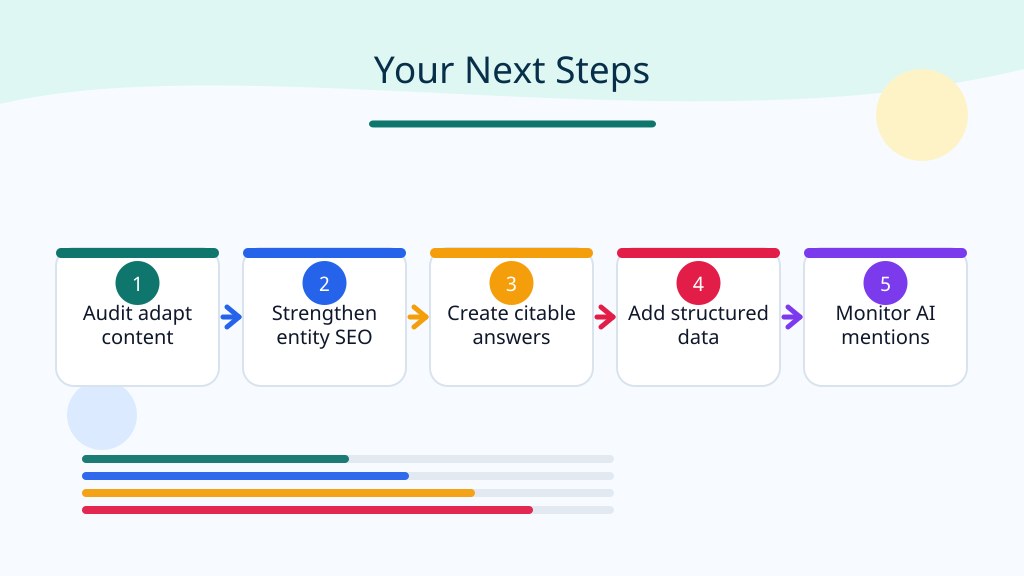
- Audit and Adapt: Review your existing content library through the lens of AEO. Identify high-value assets that can be restructured into clear, factual, and easily parsable formats that AI can readily use.
- Integrate Entity SEO: Make entity management a foundational marketing activity. Consistently build and reinforce your brand's knowledge graph across all platforms to establish authority and trust with AI systems.
- Operationalize Monitoring: Implement a continuous process for tracking how your brand and key topics are represented in AI search results. Use these insights to refine your content and address inaccuracies proactively.
- Educate Your Teams: Ensure your content, marketing, and product teams understand that the audience now includes both humans and AI. Train them on the principles of writing for answer engines, focusing on clarity, factuality, and structured data.
Embracing an AI-first strategy is the definitive step toward future-proofing your digital presence. It is the most direct path to ensuring your brand continues to be seen, heard, and trusted in an era defined by AI-driven information discovery.
FAQ
What is the difference between traditional SEO and Answer Engine Optimization (AEO)?
Traditional SEO focuses on ranking web pages in a list of links. AEO focuses on getting your brand's information and content directly featured within AI-generated summaries and conversational answers. It prioritizes structured data, factual accuracy, and clear entity recognition by language models. AEO is about becoming a citable source for AI engines like Perplexity and Google's AI Overviews, not just a link to click.
How can my brand appear in AI-generated answers like Google's AI Overviews?
To appear in AI Overviews, focus on creating clear, factual, and comprehensive content that directly answers user questions. Utilize structured data (Schema markup) to help search engines understand your content's context. Building a strong entity profile—ensuring Google understands who your brand is and what it does—is also critical. Consistent, high-quality information across your owned assets and third-party mentions establishes the authority needed for inclusion in these AI-powered summaries.
What are the key metrics for tracking success in AI search visibility?
Key metrics shift from simple rank tracking to measuring direct inclusion and brand mentions within AI responses. Track the frequency of your brand being cited as a source in platforms like Perplexity or Google AI Overviews. Monitor unlinked brand mentions across the web, as these contribute to your entity's authority. Also, analyze the sentiment and context of how AI models represent your brand, products, and services to understand your narrative in this new search landscape.
How do platforms like ChatGPT and Perplexity affect my brand's online presence?
These platforms act as new discovery channels, synthesizing information from across the web to provide direct answers. If your content is authoritative and well-structured, they can position your brand as a go-to source, driving awareness even without a direct click. Conversely, if they surface inaccurate information or competitors' content when asked about your domain, it can negatively impact perception. Proactive brand mention tracking and content optimization are essential to manage this presence.
Why is entity SEO crucial for visibility in AI search?
AI search engines like Gemini and Google's AI Overviews rely on understanding real-world 'entities'—your brand, products, people—not just keywords. Entity SEO involves building a clear, consistent, and authoritative digital footprint for these entities across various platforms. This helps AI models confidently recognize your brand as a credible source of information, making it more likely that they will cite your data and feature your content directly in their generated answers.