
AI Search Website

Core Mechanics of an AI Search Website
An AI search website answers search queries with AI-generated responses. The key test is whether an answer addresses the question, shows where its information comes from, preserves qualifications that affect its meaning, and clearly states what remains unknown.
Query handling should account for the terms used, stated constraints, and the type of response requested. Broad or ambiguous requests can be clarified before an answer is presented.
When evaluating retrieval, consider whether the selected material directly addresses the request and includes the context needed to interpret it. For time-sensitive questions, the response should also identify the dates of the information it uses.
A synthesized response should keep sourced information distinct from interpretation. Citations should lead to material that supports the adjacent statement, not merely to a related home page or domain.
The interface should let users refine a request, inspect cited material, and retain essential constraints during follow-up questions. When information is missing or conflicting, the response should state the limitation rather than imply unsupported precision.
Structuring Content for Answer Engines and Generative Overviews
Give each section a recognizable subtopic that does not depend on a long introduction. Begin with the central point, then add the conditions, evidence, examples, or limitations needed to interpret it correctly. This structure also helps readers scan the page and decide whether to continue.
- Match headings to real questions: Use descriptive headings that indicate the specific issue covered below them. Avoid vague labels such as "What You Need to Know," which provide little retrieval context.
- Keep one purpose per section: Separate definitions, procedures, comparisons, eligibility criteria, and exceptions so that important qualifications remain close to the statements they modify.
- State relationships explicitly: Name the relevant product, organization, process, or audience instead of relying heavily on pronouns. Use direct sentences and place attributes beside the entity they describe.
- Choose formats by information type: Use ordered lists for sequences, bullets for independent criteria, and short paragraphs for explanation. A table is appropriate only when readers need to compare the same attributes across alternatives.
Definitions should appear near the first use of an unfamiliar term. Comparisons need a consistent basis, while recommendations should identify who they suit and the trade-offs involved. If an answer changes by location, plan, date, or user type, place that condition beside the claim rather than in a distant disclaimer.
Finally, remove passages that restate the heading without adding information. Concise does not mean stripped of nuance: the strongest extractable block contains a direct answer, enough context to prevent misreading, and a clear boundary around what the statement does not establish.
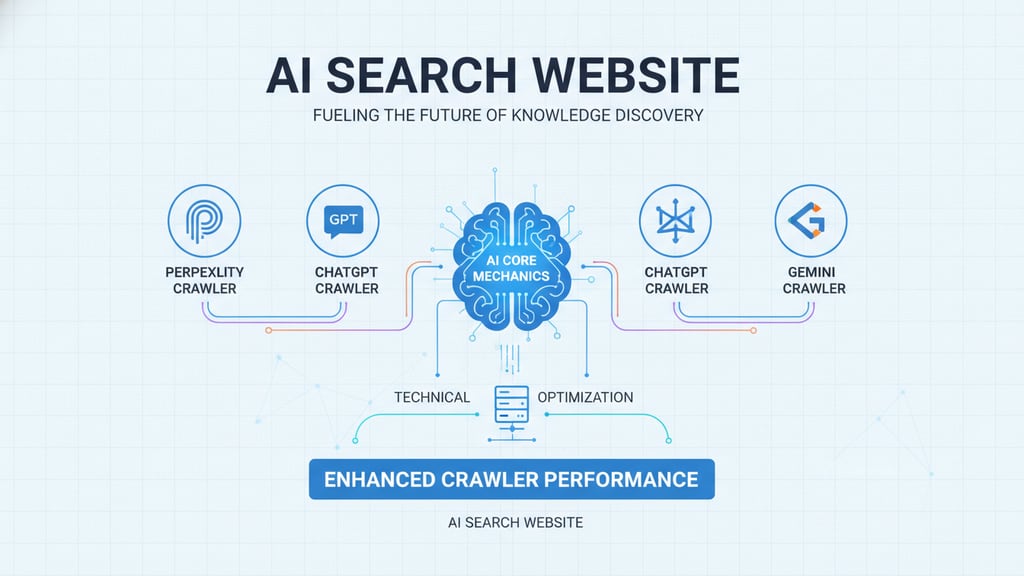
Technical Optimization for Perplexity, ChatGPT, and Gemini Crawlers
OpenAI uses dedicated crawlers such as OAI-SearchBot to surface content in ChatGPT search results, while GPTBot crawls web data used for training generative foundation models [Source: Overview of OpenAI Crawlers]. Managing these bots independently in robots.txt allows site owners to control search visibility and AI training access separately .
To optimize crawling for an ai search website, site owners can configure dedicated user agents in robots.txt, such as allowing OAI-SearchBot to surface content in search answers while managing GPTBot for generative model training.
- Audit access rules: Review robots.txt, page-level robots directives, authentication gates, firewall policies, and content-delivery-network bot controls. Distinguish deliberate restrictions from accidental blocks, and decide separately whether systems may crawl content, index it, or use it for other purposes.
- Serve complete primary content: Return meaningful HTML without requiring clicks, scrolling, or fragile client-side rendering. JavaScript can support the interface, but essential copy, headings, links, and attribution should remain available when scripts fail or execute late.
- Stabilize canonical signals: Use one preferred URL for each resource, align canonical tags with redirects and internal links, and avoid producing many parameterized versions of the same page. Every indexable URL should return the intended status code.
- Maintain discovery paths: Connect valuable pages through crawlable internal links and include canonical URLs in updated XML sitemaps. Prevent orphan pages and inspect pagination or archive paths that hide deeper material.
- Validate machine-readable data: Apply schema markup that accurately matches the visible text on the page . Matching structured data with page content ensures search systems can reliably parse information without encountering contradictions .
A technical review of an AI search website looks at which URLs were requested, the response codes they returned, any redirects along the way, and how the pages render. Where behavior shifts from one environment to another, manual fetch tests fill in what a review on its own leaves unclear.
Entity Management and Brand Citation Strategies
Entity work starts by making the organization, its products, and its subject-matter expertise consistently identifiable. Use the same preferred brand name, concise description, logo, location details, and product terminology across the website and legitimate third-party profiles. When names vary or several companies share similar names, add clarifying context rather than relying on search engines to infer the correct relationship.
- Create a central entity profile: Maintain an internal record of approved names, descriptions, founders or spokespeople, service categories, and relationships between products. Apply it when structuring content, author pages, organization details, and relevant schema.
- Connect supporting pages: Link company, product, author, and contact pages with clear internal links . Logical site architecture makes content easier for search engines and answer features to discover and evaluate .
- Earn context-rich mentions: Prioritize citations from relevant publications, associations, directories, partners, and customer resources. A brand mention beside an accurate explanation of its role is generally more informative than an isolated name in a broad list.
- Reconcile conflicting references: Review external profiles for outdated descriptions, renamed products, incorrect URLs, and duplicate listings. Request corrections where possible and ensure the website presents the current version clearly.
Publishing helpful, reliable, people-first content remains the primary foundation for visibility in web search and AI features alike . Focusing on primary source quality, clear textual information, and editorial integrity delivers better long-term performance than artificial manipulation .
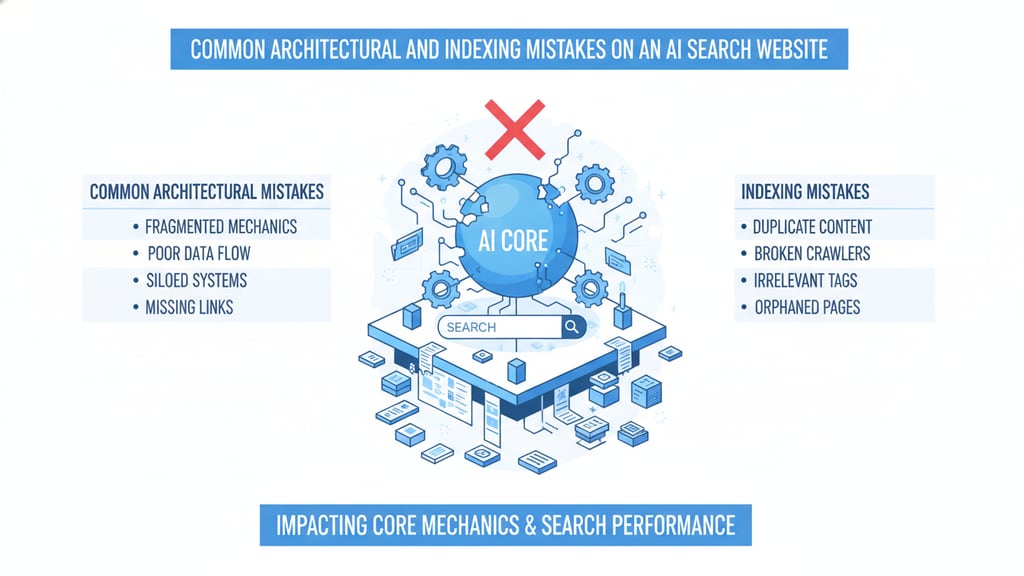
Common Architectural and Indexing Mistakes on an AI Search Website
Organize the website so that important pages serve distinct purposes and can be reached by short, obvious routes from related content. Pages that sit too deep, duplicate one another, or appear only after an interaction are architectural problems rather than writing problems, and they need to be fixed at that level.
- Fragmented topic ownership: Several pages target the same question without a clear primary resource. Consolidate overlapping material, redirect obsolete versions when appropriate, and give each surviving page a distinct purpose.
- Orphaned answer pages: Content appears in a sitemap but has no meaningful internal links. Connect it from relevant category, guide, and product pages so its relationship to the wider subject is explicit.
- Blocked or unstable access: Ensure crawling is explicitly permitted in robots.txt and that CDN or hosting infrastructure does not block legitimate search agents . Unintended crawl blocks prevent indexing and inclusion in search features .
- Uncontrolled parameter pages: Avoid duplicate URL generation by keeping internal navigation clean and fulfilling technical requirements for indexing . Ensuring pages meet baseline requirements keeps crawl pathways clear .
- Misaligned status signals: Ensure all published pages meet standard technical search requirements and remain fully indexed and eligible for search snippets . Clear status signals support reliable discovery across search features .
To keep content optimized, technical teams should make important content available in textual form and support it with relevant images or video. Verifying property settings and reviewing performance reports in Google Search Console helps teams identify potential indexing issues promptly .
Monitoring Visibility Across Generative Search Platforms
To monitor content visibility across generative platforms, site owners can review web traffic data in Google Search Console, which includes traffic from AI features within overall performance reports . Testing representative queries across platforms provides additional context on how content appears in generated answers.
For each observation, capture more than presence or absence:
- Answer inclusion: Note whether the brand, page, product, author, or research asset appears and which part of the response contains it.
- Citation destination: Record the cited URL and whether it is owned, earned, outdated, redirected, or unrelated.
- Entity accuracy: Check names, attributes, relationships, availability statements, and comparisons for ambiguity or error.
- Message alignment: Compare the generated description with the website's current positioning and the evidence published on the referenced page.
- Competitive context: Identify which alternatives appear for the same intent and what source types support their inclusion.
Focusing on recurring patterns across multiple queries provides clearer direction than reacting to an isolated output. Combining these observations with analytics for referral traffic, user engagement, and search performance helps track overall progress . Logging content updates makes it easier to evaluate which site changes contribute to traffic shifts.
Prioritize site enhancements by resolving technical crawl blocks, indexing issues, or content inaccuracies first. After publishing updates, confirm that page markup matches visible content and that search crawlers can access the resource without disruption .