Examples of Generative AI
Understanding Generative AI and Its Core Capabilities
Generative AI is software that produces new content from patterns represented in its underlying model and the instructions supplied by a user. Rather than only sorting or retrieving stored records, it can compose text, code, images, audio, and structured outputs. Its central value is synthesis: turning context, constraints, and examples into a usable draft or response.
The technology works through prompts and context. A prompt states the task, while supporting material can define the intended audience, format, terminology, or boundaries. The model then generates an output by predicting a suitable continuation. Because that process is probabilistic, two responses to the same request may differ, and fluent wording does not establish factual accuracy.
Its core capabilities include summarizing long material, rewriting content for a specific tone, extracting or reorganizing information, translating between languages, generating alternatives, and maintaining a conversational exchange across several turns. Some systems can also interpret multiple input types, allowing a user to combine text with an image, document, or dataset. These functions can support exploration and drafting without replacing subject-matter judgment.
A useful distinction is that generative systems create an answer, whereas conventional automation usually follows predefined rules and traditional search primarily returns matching resources. This flexibility also creates limits: output quality depends on the instructions, available context, model design, and review process. Understanding those boundaries helps users assign suitable work—such as ideation or first drafts—while retaining human oversight for claims, decisions, and final publication.
Prominent Examples of Generative AI in Action
The most effective deployments connect a clear input with a defined output and a review step. To integrate these capabilities, organizations can work with pre-existing platforms using targeted prompts or adapt models to align with specific internal workflows [Source: 20 Examples of Generative AI Applications Across Industries].
Marketing production: A team can provide a product brief, audience profile, approved terminology, and channel limits, then request several campaign concepts. The model might produce an email draft, social captions, and headline variations. Editors can select promising directions, correct unsupported statements, and align the final copy with the brand voice.
Software assistance: A developer can describe a function, specify the programming language, and include expected inputs and outputs. The system may propose code, test cases, documentation, or an explanation of an unfamiliar block. The generated material remains a draft to inspect against requirements and the surrounding codebase.
Creative media: Designers can combine a written scene description with composition, color, and aspect-ratio instructions to generate visual concepts. Audio teams can similarly request a narration draft or alternative dialogue while preserving defined character and style constraints.
Internal knowledge work: Staff can supply meeting notes or an approved document set and request a concise summary, categorized action list, or audience-specific explanation. This use emphasizes transformation of provided material rather than open-ended invention. Across these cases, the prominent pattern is not autonomous creation; it is guided generation followed by deliberate evaluation and refinement.
How Generative AI Transforms Search and Information Retrieval
Generative systems change search from a sequence of keyword queries and result-page visits into a conversational process. Platforms like ChatGPT, Gemini, and Google AI Overviews can present synthesized responses, preserve context for follow-up questions, and adapt explanations to a requested format . Users still need to distinguish generated synthesis from the underlying pages and assess whether the response supports its claims.
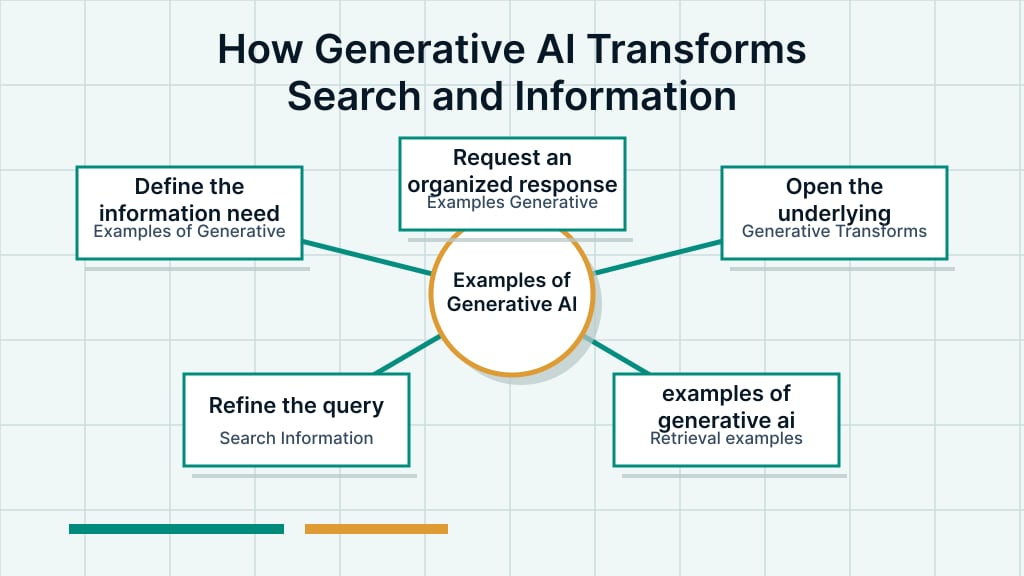
A practical retrieval sequence looks like this:
- Define the information need: State the question, relevant location or timeframe, desired depth, and any terms that require clarification.
- Request an organized response: Ask for categories, comparison criteria, assumptions, and source references rather than an unsupported single recommendation.
- Open the underlying material: Review cited pages for context, wording, publication details, and whether they directly address the question.
- Refine the query: Use follow-up prompts to resolve contradictions, narrow scope, or separate established information from inference.
These generative search models also reveal a change for publishers. Answer engines may interpret pages as collections of entities, claims, definitions, and relationships rather than as documents competing only for a conventional ranking. Clear authorship, consistent organization names, descriptive headings, and concise answer passages can make that information easier to interpret. Entity SEO supports this work by keeping details about a brand, service, and subject area coherent across relevant pages.
Visibility should therefore be evaluated beyond clicks. Teams can test recurring questions across platforms and use brand mention tracking to observe whether the organization appears, how it is described, and which pages receive attribution. Evaluating these patterns systematically helps teams review answer-engine visibility without treating any single generated response as definitive.
Key Criteria for Selecting Generative AI Tools
Start with the task rather than the most prominent product. A team drafting campaign variants needs different controls from one summarizing internal information or supporting software development. Selecting the right tool requires matching its specific capabilities to these distinct organizational workflows.
- Output fit: Test the tool with representative prompts and assess accuracy, relevance, format consistency, tone, and the amount of editing required. Examples supplied by a vendor are useful demonstrations, but trials using your own material reveal practical fit.
- Source transparency: For research and search tasks, examine whether responses identify supporting material clearly enough for a person to verify it. A polished answer without traceable information may be unsuitable for publishing or decision support.
- Data controls: Clarify what users may enter, how submitted content is handled, and which administrative permissions are available. Match those controls to the sensitivity of the intended workflow.
- Integration and usability: Consider whether the system fits existing documents, approval steps, content platforms, and team skills. An advanced model can still create friction if routine action requires extensive copying or technical setup.
- Cost and scalability: Compare subscription fees, usage limits, customization effort, review time, and expected volume rather than focusing on the advertised entry price.
Finally, evaluate reliability over several realistic cases. Define acceptance criteria before testing, retain human review for consequential outputs, and select the option whose trade-offs match the workflow—not the tool with the longest feature list.
Common Mistakes and Limitations in Implementation
A frequent mistake is treating fluent output as finished work. Generated text, images, code, and summaries can appear coherent while containing unsupported details, missing context, or an unsuitable tone. Assign an owner to review outputs against the original brief and any source material before publication or operational use.
Another problem is selecting a broad system and assuming the same workflow will transfer directly to a particular organization. A public chatbot demonstration does not define the permissions, editorial standards, data boundaries, or approval stages required for an internal deployment. Begin with a narrow use case, specify what the system may and may not do, and establish an escalation path for uncertain results.
Infographic at a glance
Visual summary of the key points on Examples of Generative AI.




Implementation also has a scope limit: generation is not a substitute for subject expertise, original evidence, or accountable judgment. Use it for clearly bounded assistance and preserve human responsibility for the final decision.
Optimizing Your Digital Presence for Answer Engines
As generative AI transforms traditional search into direct information retrieval, understanding how these systems surface information becomes increasingly important. AI features like Google AI Overviews and AI Mode use advanced models to identify and display relevant supporting links to help users explore complex topics. To align with these platforms, organizations can focus on foundational SEO best practices, such as creating helpful, reliable, people-first content and ensuring pages are indexed and eligible for snippets [Source: AI Features and Your Website]. Monitoring search performance through tools like Search Console can help track how these features contribute to overall site traffic.
Aligning a website with these evolving retrieval criteria involves maintaining technical health and content quality. Rather than relying on specialized markup or machine-readable files, site owners can focus on making content easily findable through internal links and providing a great user experience . This systematic approach helps search engines crawl and index valuable information as generative synthesis continues to shape how users discover content online.