
Generative AI Tutorial

Understanding Generative AI Fundamentals and Model Capabilities
This generative ai tutorial focuses on task definition, input requirements, output format, and evaluation criteria. These elements provide a practical framework for selecting and testing a model without treating it as a universal knowledge source.
For each task, state the objective, provide the material needed for the work, and specify the required format. Follow-up instructions can focus on particular revisions, while a final review can assess whether the result satisfies the stated requirements.
A useful generative ai tutorial connects core concepts to practical walkthroughs and defined use cases. Practical learning resources cover topics such as large language models, AI agents, coding tools, and data technologies. [Source: Generative AI Tutorials]
Capabilities should be assessed at the task level. Define the deliverable, identify the material required for the task, and evaluate whether the chosen model accepts that material and produces the required format.
Comparison table
Setting Up Your Workspace Across Major AI Platforms
Begin with one repeatable workspace rather than opening unrelated chats for every request. Create separate projects or conversation groups for content, code, research, and data work where the selected platform permits it. This keeps instructions, examples, and reference files aligned with a specific purpose without mixing incompatible context.
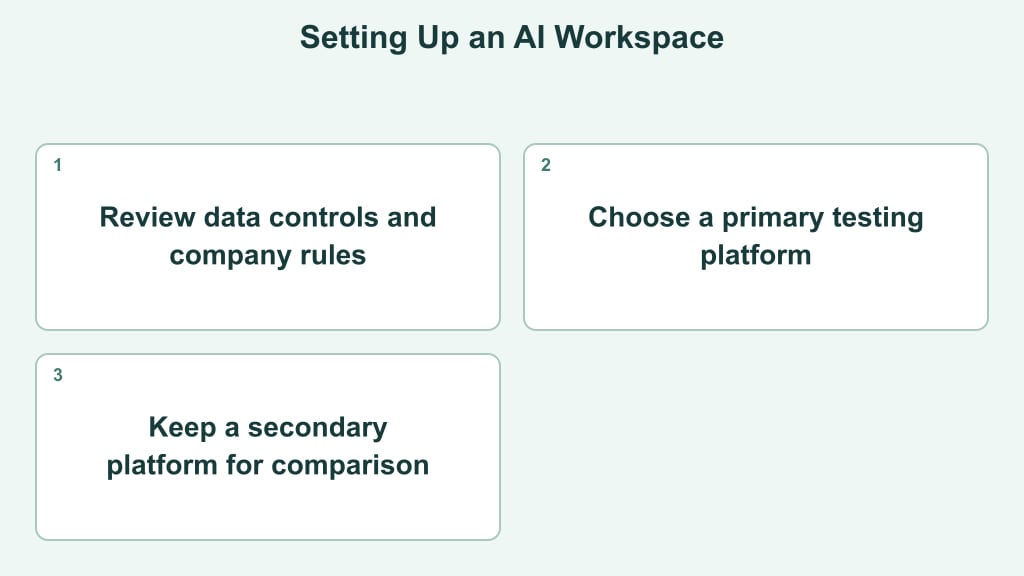
- Choose a primary testing platform: Use ChatGPT, Gemini, or Perplexity as the main environment for an initial workflow. Keep another platform available for comparison when wording, source presentation, or file handling matters to the task.
- Create a reusable context brief: Store a concise description of the organization, audience, preferred terminology, tone, exclusions, and desired output structure. Paste only the relevant portions into each session rather than loading every available document.
- Separate instructions from source material: Mark the request, background, examples, and output requirements with clear labels. For long inputs, name each file or passage and state how the model should use it.
- Prepare a prompt library: Save proven prompt structures as editable templates for drafting, analysis, extraction, and revision. Include placeholders for the objective, audience, constraints, source text, and acceptance criteria.
- Define a naming convention: Give conversations descriptive names containing the task, subject, and version. A label such as "Product comparison—buyer guide—v2" is easier to revisit than an automatically generated title.
Before adding confidential or proprietary material, review the account’s data controls and the organization’s internal rules. Configure the workspace according to those rules and test the intended workflow with non-sensitive sample material before routine use.
Core Prompting Frameworks for Accurate Outputs
Build prompts from five components: objective, context, constraints, output format, and evaluation criteria. This structure gives the model a defined task and makes weak responses easier to diagnose. A practical request might say, "Rewrite the supplied product description for procurement managers, retain all stated specifications, use 150–180 words, and return two paragraphs followed by three decision criteria."
- State one clear objective: Name the action and deliverable. Prefer "extract the contractual dates into a list" over a broad request to "analyze this document."
- Supply bounded context: Include the material needed for the task and identify its role. Tell the model whether a passage is authoritative source text, a style example, or background that may be summarized.
- Set meaningful constraints: Define audience, length, tone, exclusions, and terminology. Avoid stacking unnecessary rules that compete with the central objective.
- Specify the response shape: Request paragraphs, bullets, fields, or a table with named columns. If downstream software will consume the answer, provide an exact schema and ask for no surrounding commentary.
- Add acceptance criteria: Describe what a usable answer must contain. For example, require every recommendation to reference a supplied requirement and instruct the model to mark missing information rather than invent it.
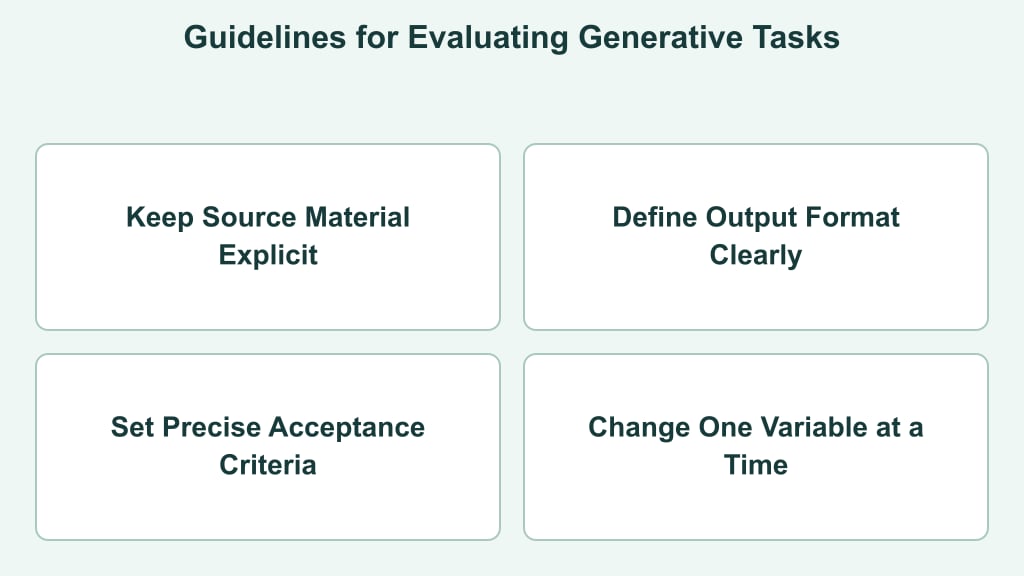
In this generative ai tutorial, the framework can be shortened to task + context + constraints + format + checks. When the first response misses the target, revise the component responsible for the problem. Add context for unsupported assumptions, tighten criteria for omissions, or show a small example when the intended structure remains ambiguous. Change one element at a time so the effect of each revision stays visible.
Practical Examples for Content, Code, and Data Tasks
Small, well-bounded exercises reveal a model's capabilities more clearly than an open-ended request. Try these examples in ChatGPT, Gemini, or another platform, then adjust the inputs and constraints to see how the output changes.
- Content brief and draft: Provide a product description, intended reader, search intent, preferred tone, and three required points. Ask for an outline first, approve its structure, and then request a 500-word draft. For an answer-engine use case, add a concise definition, descriptive subheadings, and a direct response suitable for extraction. Treat the result as an editable draft rather than finished copy.
- Code explanation and revision: Paste a short function with its programming language, expected input, and desired behavior. Ask the model to explain the logic line by line, identify ambiguous assumptions, and propose a revised version with comments. Test the code in your own workspace. If it fails, return the exact error and relevant environment details instead of asking for a generic correction.
- Data classification: Supply a small, anonymized set of customer comments and define allowed categories such as pricing, usability, support, and other. Request JSON with one category, a brief rationale, and a confidence label for each row. Review borderline cases before scaling the prompt across a larger file.
Across these tasks, keep the source material, output format, and acceptance criteria explicit. Changing one variable at a time makes it easier to determine whether an improvement came from clearer context, tighter constraints, or a better-suited model.
For a specialized data task involving a Flow based generative model, define the task, inputs, evaluation criteria, and acceptable output before selecting an implementation.
Navigating Output Limitations and Verification Strategies
Verification effort should reflect the consequence of the task. Define the required evidence, constraints, and acceptance criteria before reviewing the result.
- Separate facts from suggestions: Ask the model to distinguish statements drawn from supplied material from its own inferences. If it cannot point to the relevant passage in your input, treat the statement as unverified.
- Check primary details: Independently inspect names, dates, quotations, calculations, product specifications, and source attributions. For summaries, compare each important claim with the original document instead of checking only whether the prose sounds plausible.
- Test executable work: Run generated code in an appropriate workspace using representative inputs, edge cases, and expected outputs. Review dependencies and assumptions before incorporating the result into a larger project.
- Use a second pass deliberately: Request a critique against a short rubric covering completeness, internal consistency, required format, and unresolved uncertainty.
Divide large assignments into traceable stages and restate the current requirements before the final request. When revisions accumulate, consolidate the approved material and requirements into a clean working version. Keep publication decisions under human review, particularly for consequential claims or choices.
Optimizing AI Search Visibility and Engine Workflows
Organizational AI workflows should retain established search fundamentals. Google states that AI Overviews and AI Mode require no special optimization beyond foundational SEO practices, including technically accessible pages, people-first content, internal links, textual presentation of important information, and structured data that matches visible text. [Source: AI Features and Your Website]
- Entity clarity: Define core terminology, facts, and brand assets explicitly in your clear textual content.
- Mention tracking: Monitor how major generative search tools represent your organization to identify context gaps or factual inconsistencies.
- Systematized execution: Maintain shared instructions across your workspace to standardize prompt setting, context limits, and verification steps.
Search guidance emphasizes useful, reliable, people-first content alongside technical accessibility. For Google’s AI features, eligibility as a supporting link requires a page to be indexed and eligible to appear in Search with a snippet, although indexing and serving are not guaranteed .
To build a resilient workflow, select a primary platform, standardize your core prompting frameworks, and establish strict verification protocols for high-stakes outputs. As search models evolve, regularly audit how major platforms represent your domain expertise. Start by building two standardized prompt templates in a single workspace this week to benchmark initial quality and speed improvements.