
Generative AI Agents

Core Components of Generative AI Agents
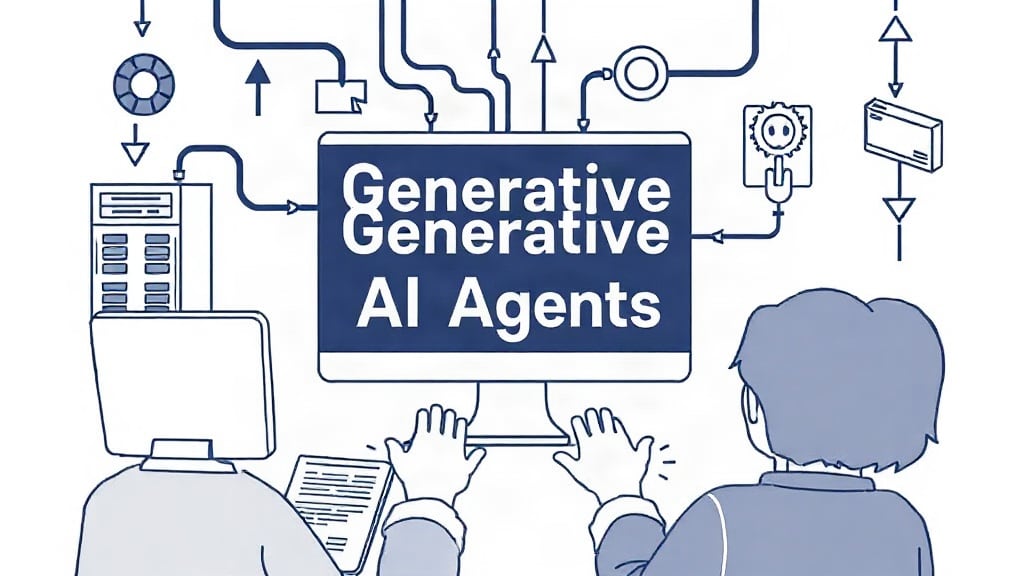
Generative AI agents combine a language model with instructions, contextual memory, external tools, and a control loop that decides what to do next. Unlike a standalone chatbot response, an agent can interpret an objective, break it into steps, retrieve relevant information, perform permitted actions, inspect the result, and continue or request human input.
The model provides the reasoning and content-generation layer, but it is only one part of the system. The following components determine how reliably an agent operates:
- Objective and instruction layer: System prompts, policies, task definitions, and examples establish the agent's role, boundaries, priorities, and expected output.
- Context and memory: A working context holds the current conversation and task state. Optional longer-term memory can retain approved preferences, prior actions, or account details for later use.
- Knowledge retrieval: Search and retrieval mechanisms supply relevant material from enterprise documents, databases, or approved external sources. This grounds responses in information beyond the model's built-in knowledge.
- Tools and connectors: APIs allow generative AI agents to query business systems, create records, send messages, run calculations, or trigger predefined workflows.
- Planning and orchestration: A controller selects tools, sequences subtasks, manages dependencies, and determines whether the objective has been completed.
- Controls and observability: Permissions, validation rules, approval gates, logs, and monitoring constrain actions and make behavior reviewable.
These elements may reside in one platform or span several services. Their design should reflect the task: a research assistant may emphasize retrieval and citations, while an operational agent requires stricter permissions, state management, and action validation.
Evaluating Autonomous Capabilities for Enterprise Workflows
Begin by defining the decisions and actions the agent may perform without approval. Autonomy is not a single feature: an agent might independently gather information yet require confirmation before changing a customer record, publishing content, or contacting a supplier. Evaluate each workflow step separately rather than assigning one autonomy level to the entire process.
Use practical criteria tied to the operating environment:
- Task clarity: Favor processes with explicit inputs, completion conditions, and exception rules. Ambiguous objectives make it harder to distinguish a valid decision from a plausible but unsuitable one.
- Action reversibility: Determine whether an incorrect action can be detected and undone. Drafting a response is easier to supervise than executing an irreversible transaction.
- Data reliability: Check whether required records are current, consistently structured, and available through authorized systems. Weak source data limits autonomous performance regardless of model quality.
- Tool boundaries: Give the agent only the permissions needed for its assigned steps. Read, draft, approve, and execute privileges should be evaluated independently.
- Exception frequency: Review how often cases depart from the standard path. Frequent judgment calls may justify routing to a person rather than expanding the agent's discretion.
- Verification method: Define how outputs will be checked through rules, source comparison, sampling, or human review. Evaluation should cover both the final result and the sequence of actions used to reach it.
A controlled trial should include routine cases, incomplete inputs, conflicting instructions, unavailable tools, and escalation scenarios. Measure completion quality, unnecessary actions, correction effort, and adherence to approval rules. Enterprise readiness depends less on apparent conversational fluency than on predictable behavior within clearly documented boundaries.
Practical Applications Across Business Operations
Useful agent applications usually combine content generation with retrieval, classification, and a limited operational action. The strongest candidates involve recurring work, accessible source material, and a clear point at which a person can review or accept the result.
- Customer service triage: An agent can classify an incoming request, retrieve relevant account and policy information, draft a reply, and route unusual cases to a specialist. Execution choices include restricting the agent to approved knowledge, requiring review for sensitive requests, and logging the sources used.
- Sales preparation: A research agent can assemble account context from authorized CRM records, summarize prior interactions, and suggest meeting questions. It may create a draft briefing while leaving record changes and outbound communication to the account owner.
- Internal knowledge support: Employees can ask operational questions through an interface built with ChatGPT, Gemini, or another approved model. The agent retrieves company documentation, presents a concise answer, identifies the supporting material, and escalates when sources conflict.
- Procurement coordination: An agent can extract requirements from a request, compare them with catalog entries, identify missing fields, and prepare a purchase draft. Approval gates should remain aligned with existing purchasing authority.
- Answer-engine visibility monitoring: A marketing agent can track brand mentions across search features and record whether expected descriptions appear. Brand mention tracking can reveal changes, but it cannot guarantee inclusion, wording, or ranking [Source: AI Features and Your Website]. For more on this topic, see What Is Generative AI, and How Does It Work?.
For entity SEO work, the same pattern can help teams reconcile organization names, product descriptions, and attributed facts across approved pages. This provides an operational queue for editors; it does not guarantee inclusion in an answer engine . Each application should therefore produce reviewable evidence, not merely fluent text.
Deploying Generative AI Agents in Existing Infrastructure
Deploy generative AI agents as governed services around existing systems rather than as replacements for them. Start by mapping the applications, data stores, identity providers, APIs, and approval queues involved in one bounded workflow. List which actions the agent may execute, which information it may retrieve, and where a person must review its output.
- Separate reasoning from execution: Let the model propose a task or tool call, but route the request through a controlled service that validates permissions, parameters, and business rules before acting.
- Use existing identity controls: Assign service identities with narrowly defined access instead of allowing an agent to inherit broad user or administrator privileges.
- Build an auditable context layer: Retrieve approved documents, product facts, and entity records through managed connectors. Log the sources supplied to the model and the actions taken afterward.
- Design operational fallbacks: Set timeouts, retry limits, exception queues, and manual handoffs so interrupted workflows do not continue unpredictably.
For marketing and search operations, connectors can bring brand guidelines, verified entity data, and approved claims into content workflows. Keep publication separate from generation: an editor should validate factual accuracy, brand mentions, and answer-engine visibility requirements before material enters a content management system.
Run the deployment in a restricted environment with representative requests and edge cases. Monitor tool failures, unauthorized access attempts, unsupported answers, latency, and the frequency of human intervention. Expand access only when the operational owner can explain how the agent behaves, reverse its actions where feasible, and suspend it without disrupting the underlying enterprise workflow.
Technical and Operational Limitations
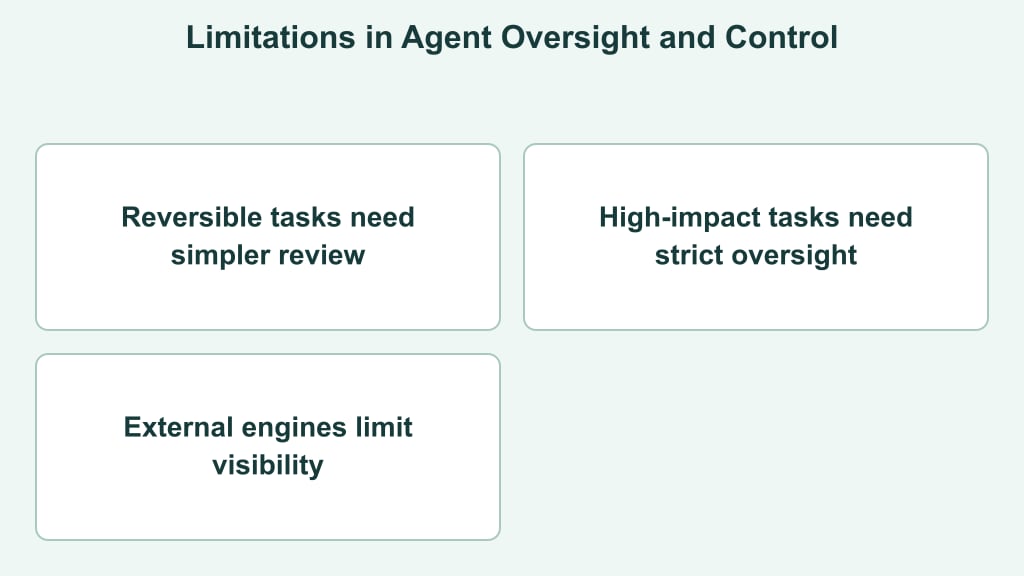
The output of the referenced options can appear coherent even when the underlying reasoning, retrieved context, or selected action is wrong. Their autonomous capabilities therefore require controls that reflect the consequences of a mistake, not merely the apparent quality of a response.
Model behavior can vary when prompts, context, tools, or provider versions change. Long workflows compound that uncertainty: an early classification error may direct later steps toward the wrong system or record. Retrieval does not eliminate the problem because source repositories may contain stale, conflicting, incomplete, or poorly permissioned material. Tool integrations introduce additional failure points, including malformed parameters, expired credentials, API changes, timeouts, and duplicate actions after retries.
Operational limits are equally important. Evaluating open-ended work is difficult because acceptable answers may differ while sounding plausible. Human reviewers can become a bottleneck or approve outputs mechanically. Logs may capture an action without making the decision process fully interpretable, while costs and latency fluctuate with context size and tool calls.
Answer-engine applications add another constraint: visibility is not controlled by the organization alone. Search features and conversational interfaces can summarize sources differently. Brand mention tracking can reveal changes, but it cannot guarantee inclusion, wording, or ranking . Content created for these environments still requires verified entity data and clear source ownership.
Match oversight to reversibility. Drafting, classification, and recommendations are generally easier to review than publishing, updating customer records, or initiating transactions. For consequential enterprise workflows, restrict permissions, require explicit approval, and maintain a manual path when an agent lacks context or confidence.
Integration Frameworks and Initial Deployment Steps
Choose an integration pattern based on workflow complexity and control requirements. A direct model API suits a contained drafting assistant, while retrieval-augmented generation adds access to internal knowledge. Tool-calling frameworks connect models to business functions, and multi-agent arrangements should be reserved for cases where distinct roles provide a clear operational advantage.
- Define one bounded outcome: Specify the request, expected output, authorized actions, owner, and conditions requiring human review. Avoid beginning with an open-ended mandate to automate an entire function.
- Establish a controlled knowledge set: Select current documents and structured entity records, assign owners, enforce access rules, and define how updates are propagated.
- Create tool contracts: Describe permitted functions, required parameters, validation rules, idempotency behavior, and error responses. Expose only the capabilities needed for the selected workflow.
- Build an evaluation set: Include routine requests, ambiguous inputs, missing information, conflicting sources, permission failures, and attempted instruction manipulation. Assess task completion and policy compliance separately.
- Launch with staged authority: Begin in observation or recommendation mode, then permit limited execution after reviewers understand common failure patterns. Preserve logs, rollback options, and a clear shutdown mechanism.
For search and discovery work, monitor how a brand and its core entities appear across conversational search interfaces before revising content. Observing mentions, factual consistency, and source attribution provides directional operational evidence rather than guaranteed platform outcomes.
Select a framework based on data sensitivity, action reversibility, and available oversight. Practical adoption requires an accountable workflow owner, a narrow use case, defined failure boundaries, and a supervised pilot prior to granting broader access.