
What Makes Generative AI Unique
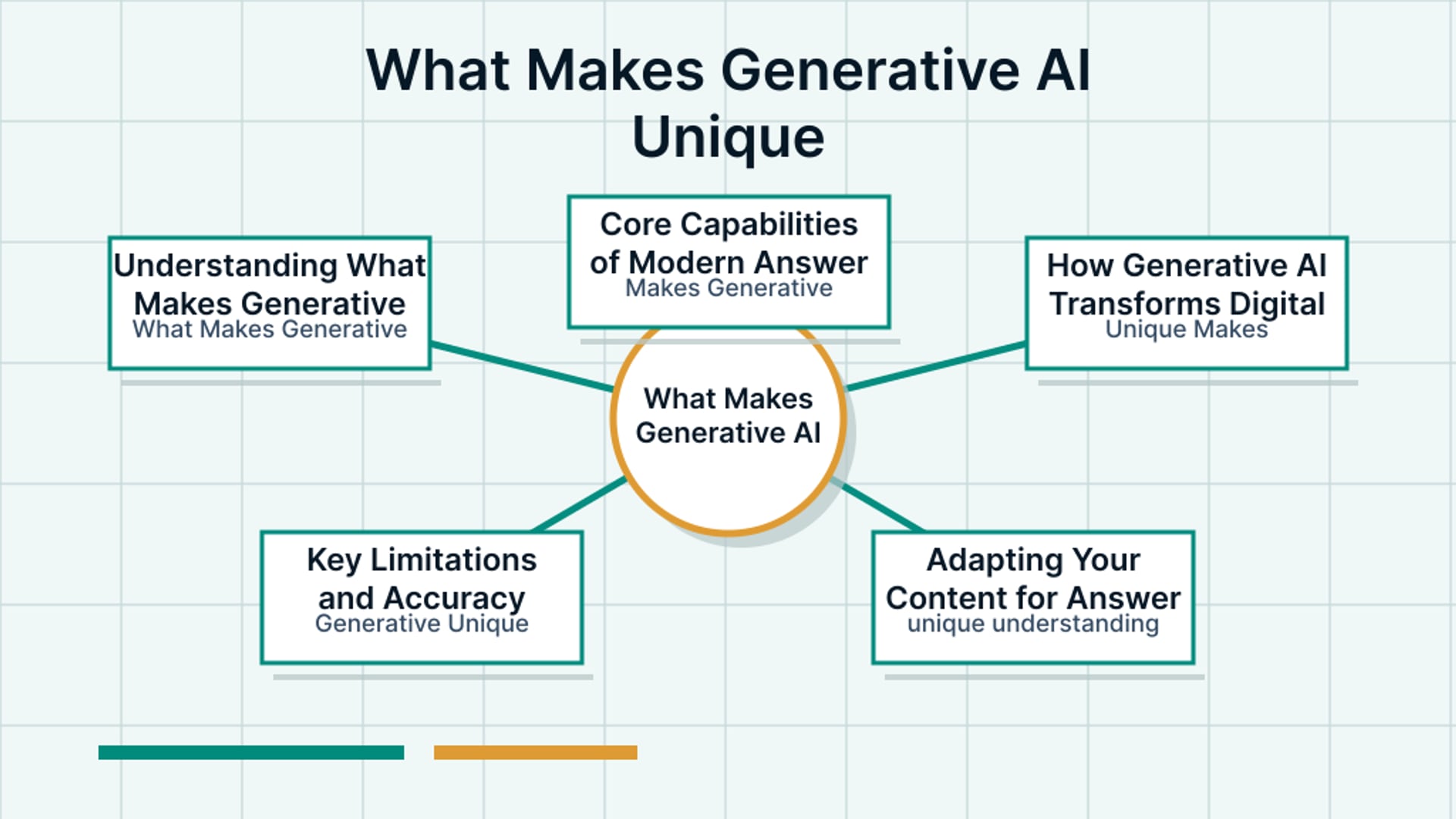
Understanding What Makes Generative AI Unique
Generative AI creates content in response to an input: an explanation, an image, a piece of code or another output. What makes generative AI unique is this capacity to produce a new response from learned patterns, rather than simply return a stored record. Creating a convincing answer, however, is not the same as verifying that answer.
IBM's explanation of generative AI describes models that learn patterns and relationships from training data and use them to generate content. Large language models are one category; generative systems can also work with images, audio and other media. Training establishes the model's capabilities, while further tuning can adapt it to particular tasks.
Consider a hypothetical support workflow. A database lookup retrieves the recorded delivery date. A classifier labels the message as a delivery question. A generative assistant drafts a reply explaining the date in a friendly tone. These are distinct jobs, and a useful application might combine them. For a broader introduction, read our guide to what generative AI is and how it works.
Core Capabilities of Modern Answer Engines
An answer engine can combine retrieval with generation. In retrieval-augmented generation, or RAG, an application finds relevant material and supplies it as context for a model's response. Google Cloud's RAG overview explains this combination of information retrieval and language generation. It also notes that supplying relevant facts can reduce factual errors, while irrelevant retrieved material can still produce an incorrect or off-topic answer.
Retrieval and generation therefore deserve separate checks. For example, imagine asking an assistant to compare two subscription plans using their current product pages. Did it retrieve the right pages? Did it retain the billing period and exclusions? Does the final comparison accurately reflect those pages? A readable comparison is useful only after those questions have satisfactory answers.
For your own evaluation, distinguish the answer, its supporting material and your assessment of accuracy. Record which sources were available to the application and which claims you verified yourself. This keeps the exercise focused on observable evidence instead of treating a fluent paragraph as proof that the system understood every detail.
How Generative AI Changes a Content Workflow
For a content team, the practical question is not merely what makes generative AI unique, but where generated output belongs in the editorial process. A sensible starting point is a bounded assignment: draft an introduction from approved notes, suggest alternative headings, or turn a verified explanation into a first draft for another audience.
Write the brief before requesting the draft. State the reader's question, the facts that must remain unchanged, the permitted sources and the desired format. If a product limitation matters, put it in the brief explicitly. Ask the editor to check that limitation in the finished copy rather than assuming it survived every rewrite.
Separate content quality from visibility measurement. In an AEO review, record the query you tested, the date, the answer returned and any links shown. Use those observations to identify questions worth investigating. Avoid turning one favorable example into a promise about how every answer engine will describe or recommend a business.
Key Limitations and Accuracy Checks
Google Cloud identifies factual accuracy as a challenge for language models and describes grounding as a way to supply relevant information. Its explanation also makes clear why retrieval quality matters. Adding a source is not enough if the retrieved passage does not address the question. Our article on generative AI search explores the search context further.
Use a claim-by-claim review for publishable content. Highlight names, figures, comparisons and statements about what a service can achieve. Open the cited material and find the passage that supports each important assertion. If you cannot establish the connection, remove the claim, narrow it to what the source actually says, or pause publication while you investigate.
Apply the same discipline to translations. Approve the original first, then check the translated version for changed meaning, missing qualifications and unnatural wording. Read FAQ answers as carefully as the main sections. A cautious statement in the body should not become an unconditional promise in a short answer at the bottom of the page.
Adapting Your Content for Answer Engine Optimization
Google Search Central's guidance on AI features says established SEO practices remain relevant to AI Overviews and AI Mode. There is no special schema markup required for these features. A supporting page must be indexed and eligible for a search snippet, but meeting the requirements does not guarantee indexing or inclusion.
Start with an editorial checklist: answer the stated question clearly, make important information available as text, connect relevant pages with descriptive internal links, and keep structured data consistent with the visible content. Treat these as publishing fundamentals, not a formula for guaranteed recommendations. Google's guidance concerns its own Search features; do not assume identical requirements across all platforms.
The useful distinction is between producing content and approving it. Generative AI contributes the draft; your workflow must decide whether the result is accurate, relevant and ready for readers. Begin with one controlled use case, review its outputs against your sources, and extend the workflow only when those checks are working.
Frequently Asked Questions
What makes generative AI unique compared with a database lookup?
A lookup retrieves stored information. A generative model produces content from learned patterns and the context supplied to it. An application can combine both: retrieve an approved record, then draft a response explaining it.
Does a cited answer still need editorial review?
Yes. Check whether the cited passage supports the actual statement, not just the general topic. For a comparison, verify the conditions and exclusions as well as the headline claim before approving the text.
Can AEO work guarantee inclusion in Google's AI answers?
No. Google says compliance with its requirements and best practices does not guarantee inclusion. Plan around useful content, technical eligibility and documented observations; do not present an optimization service as a promise of placement.